Bathurst is almost here, with less than 2 weeks to go!
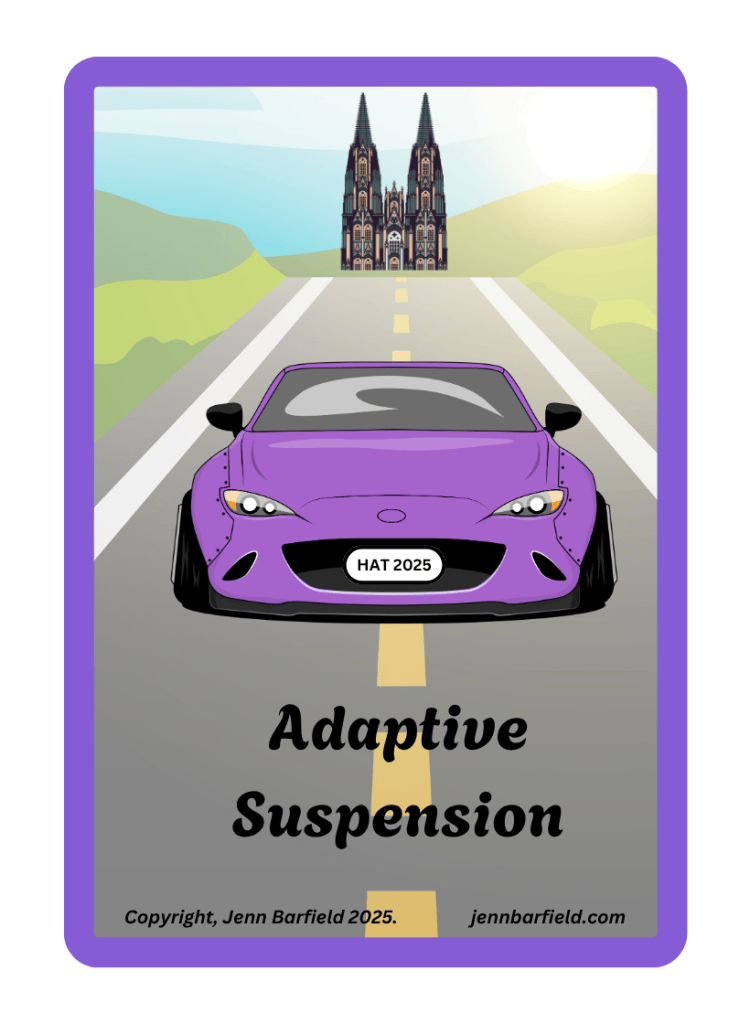
The engines are getting louder, the excitement is building and soon it will be time to switch on the out-of-office message. We have also reached the sixth Drive Your Career capability: Adaptive Suspension.
We have checked behind us, illuminated what matters, mapped possibilities, selected a gear and taken hold of the wheel. But no journey, career or race track comes without changing conditions, unexpected corners or a few bumps along the way.
Adapting is often reduced to “bouncing back” or “changing course”. Yet a shock absorber does not pretend the bump never happened. It helps control the movement and maintain stability as the vehicle continues across changing terrain.
Beyond bouncing back
The phrase “bouncing back” can suggest returning quickly to exactly who or where we were before something changed. It may also imply that successful adaptation should leave little evidence of the impact.
But people are not rubber balls, and experiences do not always return us neatly to our previous shape.
Some changes affect our energy, confidence, priorities, relationships or sense of direction. Acknowledging that impact does not mean we have failed to adapt. It may be an important part of understanding what the next section of road requires.
Adaptation can involve responding to the conditions as they are, rather than pretending they have not changed. It may require a different pace, additional support, a revised direction or a more sustainable way of continuing.
The bump does not need to become a gift
There can be pressure to find a positive lesson in every difficult experience. Sometimes people are encouraged to identify how adversity made them stronger before they have had space to acknowledge what it disrupted, depleted or cost.
Not every bump needs to be renamed as a gift.
At the same time, an experience may leave behind knowledge, insight, capability or a clearer understanding of what matters. Recognising something that can be carried forward does not require us to deny the difficulty or become grateful that it happened.
Both things can be true: an experience may have cost us something, and there may still be something we can recover from it.
Regenerative Adaptation
Then I encountered an even more intriguing automotive possibility: regenerative shock absorber technology. My curiosity engine immediately started revving. 🧐⚡
The idea of controlling suspension movement while recovering some of the energy created by road vibrations prompted a rather different question about adaptation.
This week’s downloadable activity, Regenerative Adaptation, offers an opportunity to explore that connection from an unusual automotive and electric-vehicle perspective.
The downloadable contains the prompts and visual space needed to consider what this idea might mean within your own career-life journey, without prescribing what you should recover or how you should use it.
What can you recover and reuse without denying what the experience cost you?
Download the full Regenerative Adaptation activity here:
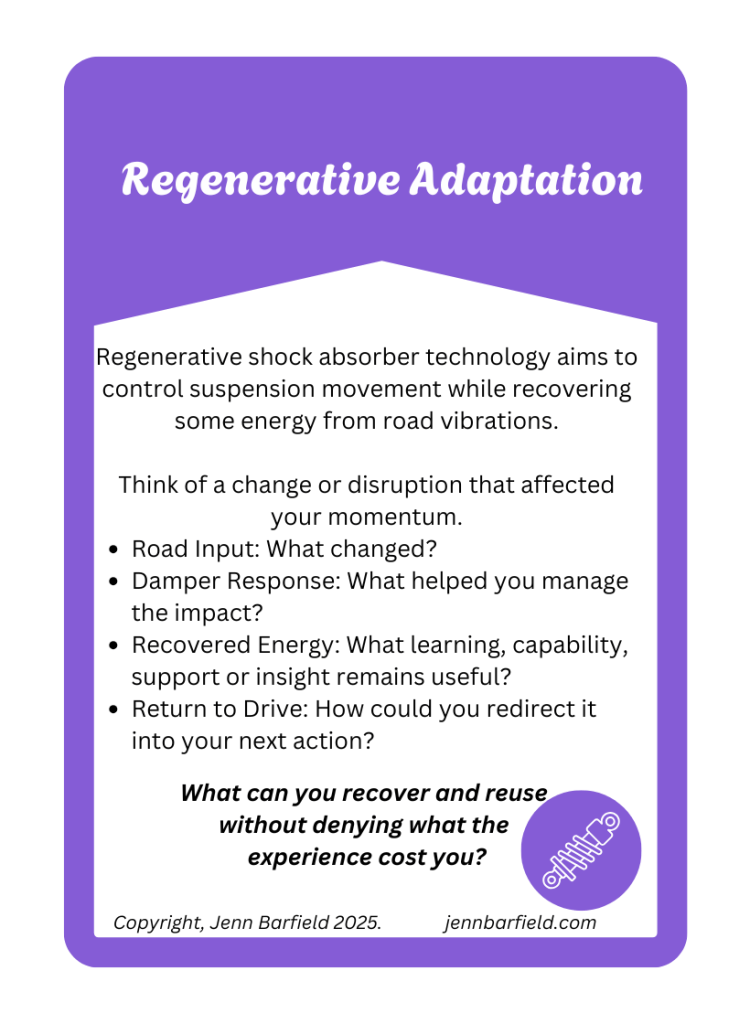
What comes into view may be a strength, boundary, insight, need or source of energy. It may also be the recognition that something still requires care. There is no requirement to convert every difficult experience into something productive.
A little team curiosity spark
Have you ever considered what wheel rotation might reveal about workload balance, flexibility and the risk of people becoming worn down?
I will leave that question turning rather than unpacking the metaphor here. It is one of the automotive-inspired ideas I use to help teams become curious about sustainability, contribution and how work is carried over time. Reach out if you would like to explore this idea further or discuss how my automotive-inspired approach could help your team gain clarity and get unstuck.
Continuing across changing terrain
Adaptation is not about denying the bump, immediately returning to our previous pace or proving that nothing affected us. It involves noticing what has changed and considering what may help us continue with greater awareness and stability.
Sometimes we adjust the suspension. Sometimes we slow down. Sometimes we choose another road. And sometimes we recognise that maintenance and support are part of continuing the journey, not evidence that we have failed to navigate it.
What can you recover and reuse without denying what the experience cost you?
We have now travelled through all six ‘Drive Your Career’ capabilities. During Bathurst race week, we will take one final playful detour and discover which Inner Driver may currently be sitting behind the wheel.
Reach out directly to chat more about my Drive Your Career: Shift Gears with Hope and Purpose approach and how it can support you or your team to get curious, gain clarity and get unstuck.

